Search engine optimization can feel overwhelming. Acronyms. Algorithms. Technical jargon. Conflicting advice.
If you have ever read an SEO article and thought, “I should probably know what that means,” you are not alone.
This SEO Glossary was created to solve that problem.
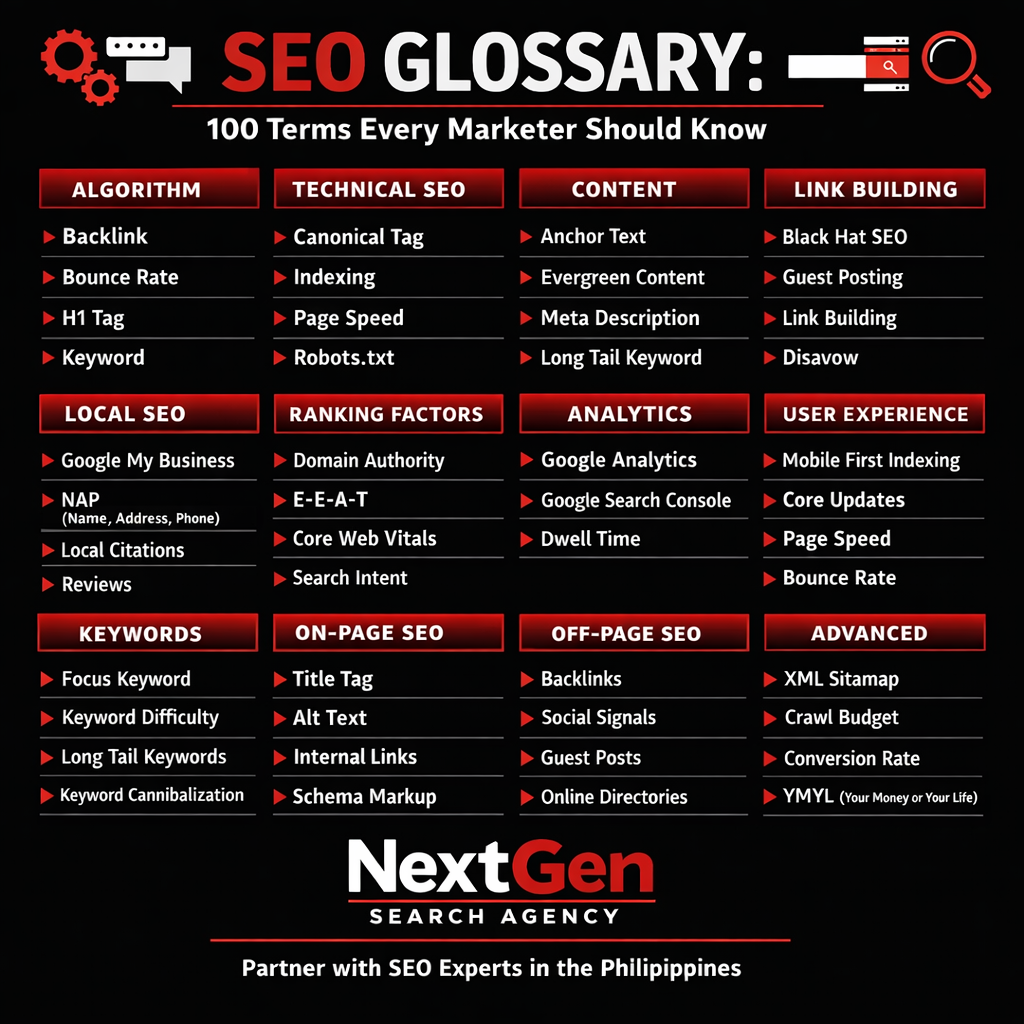
Welcome to the NextGen SEO Glossary, your complete guide to 100 essential SEO terms every marketer, business owner, and digital strategist should understand. Whether you manage your own campaigns or work with an SEO agency, this resource will help you speak the language of search with clarity and confidence.
Bookmark this page. Share it with your team. Refer back whenever needed.
Let’s get started.
What Is an SEO Glossary?
An SEO glossary is a structured reference guide that defines important search engine optimization terms in clear, practical language. Instead of vague definitions, this glossary explains what each term means and why it matters in real campaigns.
Search engines evolve constantly. Algorithms change. Best practices shift. But foundational terminology remains critical to understanding strategy.
A
1. Algorithm
An algorithm is a set of rules search engines use to determine how pages are ranked in search results.
Google’s algorithm evaluates hundreds of ranking factors, including content quality, backlinks, page speed, and user experience.
2. Algorithm Update
An algorithm update refers to changes made to search engine ranking systems.
Major updates like Google Core Updates can significantly impact rankings across industries.
3. Anchor Text
Anchor text is the clickable text in a hyperlink.
Search engines use anchor text to understand what the linked page is about. Over-optimized anchor text can trigger penalties.
4. Alt Text
Alt text describes an image for accessibility and search engines. It helps search engines understand visual content and improves image SEO.
5. Authority
Authority refers to a website’s credibility and trustworthiness in the eyes of search engines. It is influenced by backlinks, content quality, and domain history.
B
6. Backlink
A backlink is a link from one website to another.
Backlinks remain one of the strongest ranking factors because they act as votes of confidence.
7. Black Hat SEO
Black Hat SEO refers to manipulative tactics that violate search engine guidelines. Examples include keyword stuffing and link schemes.
8. Bounce Rate
Bounce rate measures the percentage of visitors who leave a page without interacting further.
9. Broken Link
A broken link points to a page that no longer exists. Broken links harm user experience and SEO performance.
10. Branded Keyword
A branded keyword includes a company’s brand name, such as “NextGen Search Agency SEO services.”
C
11. Canonical Tag
A canonical tag tells search engines which version of a page should be considered the primary version when duplicate content exists.
12. Click Through Rate (CTR)
CTR measures how often users click your result after seeing it in search results.
13. Cloaking
Cloaking is the practice of showing different content to search engines than to users. It violates guidelines.
14. Content Marketing
Content marketing involves creating valuable content to attract and engage a target audience.
15. Core Web Vitals
Core Web Vitals are performance metrics used by Google to measure user experience. They include loading speed, interactivity, and visual stability.
D
16. Domain Authority
Domain Authority is a third-party metric predicting how likely a website is to rank. It is not an official Google metric.
17. Duplicate Content
Duplicate content refers to identical or substantially similar content appearing on multiple URLs.
18. Dwell Time
Dwell time measures how long a user stays on a page before returning to search results.
19. Disavow
Disavowing links means telling search engines to ignore specific backlinks.
20. Directory Submission
Directory submission involves listing a website in online directories. Its SEO value today is limited.
E
21. E-E-A-T
E-E-A-T stands for Experience, Expertise, Authoritativeness, and Trustworthiness. It is part of Google’s quality evaluation framework.
22. External Link
An external link points to a different domain.
23. Evergreen Content
Evergreen content remains relevant over time and continues attracting traffic.
24. Entity
An entity is a distinct concept that search engines understand independently of keywords.
25. Engagement Rate
Engagement rate measures user interaction with content.
F
26. Featured Snippet
A featured snippet is a highlighted search result that appears at the top of results, often called Position Zero.
27. Focus Keyword
A focus keyword is the primary term a page is optimized for.
28. Freshness
Freshness refers to how recently content was updated.
29. Funnel
In SEO, funnel refers to stages of the buyer journey: awareness, consideration, and decision.
30. Footer Link
A footer link appears at the bottom of a webpage.
G
31. Google Analytics
Google Analytics tracks website traffic and user behavior.
32. Google Search Console
Google Search Console helps monitor search performance and indexing.
33. Google Business Profile
Google Business Profile manages local business listings.
34. Gray Hat SEO
Gray Hat SEO uses questionable but not clearly prohibited tactics.
35. Guest Posting
Guest posting involves publishing content on another website to build authority and backlinks.
H
36. H1 Tag
The H1 tag is the main heading of a page.
37. Hreflang
Hreflang tags tell search engines which language version of a page to show.
38. HTML Sitemap
An HTML sitemap is a user-friendly list of site pages.
39. HTTP vs HTTPS
HTTPS indicates a secure connection. Security is a ranking factor.
40. Head Keyword
A head keyword is a short, high-volume search term.
I
41. Indexing
Indexing is the process of storing webpages in a search engine database.
42. Internal Link
An internal link connects pages within the same domain.
43. Impressions
Impressions represent how often a page appears in search results.
44. Intent
Search intent describes the reason behind a user’s query.
45. Image Optimization
Image optimization reduces file size and improves search visibility.
J
46. JavaScript SEO
JavaScript SEO focuses on optimizing sites that rely heavily on JavaScript rendering.
47. JSON-LD
JSON-LD is a structured data format recommended by Google.
K
48. Keyword
A keyword is a search term users type into search engines.
49. Keyword Cannibalization
This occurs when multiple pages compete for the same keyword.
50. Keyword Difficulty
Keyword difficulty estimates how hard it is to rank for a term.
L
51. Landing Page
A landing page is a page designed to convert visitors.
52. Link Building
Link building is the process of acquiring backlinks.
53. Long Tail Keyword
A long tail keyword is a specific phrase with lower search volume but higher intent.
54. Local SEO
Local SEO optimizes visibility for location-based searches.
55. Log File Analysis
Log file analysis reviews server logs to understand crawl behavior.
M
56. Meta Description
A meta description summarizes page content in search results.
57. Meta Title
The meta title is the clickable headline in search results.
58. Mobile First Indexing
Mobile First Indexing means search engines primarily use the mobile version of content for ranking.
59. Manual Penalty
A manual penalty is issued by human reviewers.
60. Metrics
Metrics are measurable data points like traffic and conversions.
N
61. NAP
NAP stands for Name, Address, Phone number consistency in local SEO.
62. Noindex
Noindex prevents search engines from indexing a page.
63. Nofollow
Nofollow tells search engines not to pass ranking value through a link.
O
64. On Page SEO
On Page SEO refers to optimizing elements within a website.
65. Off Page SEO
Off Page SEO refers to external ranking signals.
66. Organic Traffic
Organic traffic comes from unpaid search results.
67. Orphan Page
An orphan page has no internal links pointing to it.
P
68. Page Speed
Page speed measures loading time.
69. PageRank
PageRank is an early ranking algorithm developed by Larry Page and Sergey Brin.
70. Pillar Page
A pillar page covers a broad topic and links to related content.
71. PPC
PPC stands for Pay Per Click advertising.
72. Primary Keyword
The primary keyword is the main term targeted by a page.
Q
73. Query
A query is a user’s search input.
74. Quality Score
Quality Score is a metric used in Google Ads to evaluate ad relevance.
R
75. Rank Tracking
Rank tracking monitors keyword positions.
76. Redirect
A redirect sends users from one URL to another.
77. Robots.txt
Robots.txt instructs search engines which pages to crawl.
78. Rich Snippets
Rich snippets display enhanced search results using structured data.
S
79. Schema Markup
Schema markup adds structured data to webpages.
80. Search Engine Results Page (SERP)
A SERP is the page displayed after a search query.
81. Search Volume
Search volume measures how often a keyword is searched.
82. Sitemap
A sitemap lists pages for search engine crawling.
83. Spam Score
Spam Score estimates the likelihood a site appears spammy.
84. Structured Data
Structured data helps search engines understand content context.
T
85. Technical SEO
Technical SEO focuses on backend optimization.
86. Thin Content
Thin content provides little value to users.
87. Title Tag
The title tag defines the page headline in search results.
88. Topical Authority
Topical authority refers to deep expertise on a subject.
U
89. URL Structure
URL structure refers to how URLs are organized.
90. User Experience (UX)
UX measures overall usability and satisfaction.
V
91. Voice Search
Voice search involves spoken queries.
W
92. White Hat SEO
White Hat SEO follows search engine guidelines.
93. Web Crawlers
Web crawlers are bots that discover content.
94. Webmaster Guidelines
Webmaster Guidelines outline best practices.
X
95. XML Sitemap
An XML sitemap helps search engines find pages.
Y
96. YMYL
YMYL stands for Your Money or Your Life content categories.
Z
97. Zero Click Search
Zero Click Search occurs when users get answers directly from search results.
Additional Advanced SEO Terms
98. Crawl Budget
Crawl budget refers to how many pages a search engine crawls within a timeframe.
99. Conversion Rate
Conversion rate measures completed desired actions.
100. Content Gap
Content gap identifies missing topics competitors cover.
Why This SEO Glossary Matters
Understanding terminology is the first step toward building sustainable search growth. Strategy without clarity leads to wasted budgets and inconsistent results.
A strong SEO glossary is not just about definitions. It is about aligning your marketing team around shared language and measurable outcomes.
Search engine optimization is no longer optional. It is foundational.
If you truly understand this SEO glossary, you already have an edge over most businesses that treat SEO as guesswork.
That said, knowing the terms and executing a high-performing strategy are two different things. Implementation requires experience, testing, and consistent refinement.
At NextGen Search Agency, we combine technical SEO, content strategy, and performance marketing to help businesses in the Philippines and beyond generate high-converting leads and long-term growth. We are not here to chase vanity metrics. We focus on measurable revenue impact.
If you are serious about improving organic visibility and building a predictable sales pipeline, explore how we approach SEO and paid media strategy at nextgensearch.agency.
Let’s turn knowledge into growth.
Resources
Google Search Central
Google Analytics Help Center
Google Search Console Help
Google Ads Help Center
For expert SEO support, visit https://www.nextgensearch.agency