Running Google Ads today is very different from how it was just a few years ago. Automation has taken center stage, and bidding strategies powered by machine learning now influence how ads are shown, how much you pay, and ultimately how profitable your campaigns become. For many advertisers, this shift raises an important question: how do you strike the right balance between manual control and automation?
Google Ads smart bidding promises efficiency, scale, and better use of data. Manual bidding offers precision, transparency, and a sense of control that many advertisers still value. The challenge is not choosing one and ignoring the other, but understanding when and how to use each approach together.
This article explores how to balance manual bidding and Google Ads smart bidding in a practical, real world way. We will break down how each bidding method works, when one makes more sense than the other, and how advertisers can transition smoothly without risking performance. The goal is to help you make informed decisions that align with your data, goals, and resources.
Understanding Manual Bidding in Google Ads
Manual bidding is the traditional way of managing bids in Google Ads. Advertisers set bids themselves, usually at the keyword or ad group level, based on how much they are willing to pay for a click.
With manual bidding, you control:
- Maximum cost per click for keywords
- Bid adjustments for devices, locations, audiences, and schedules
- Testing and optimization based on your own analysis
This level of control makes manual bidding appealing, especially for advertisers who want to understand exactly how their budget is being spent.
Advantages of Manual Bidding
Manual bidding still has a place in modern Google Ads accounts. Some of its key benefits include:
- Full transparency into how bids are set
- Greater control over individual keywords
- Easier testing of new campaigns or offers
- Useful when data volume is low
For new campaigns, manual bidding often helps advertisers gather initial performance data before moving to automation.
Limitations of Manual Bidding
Despite its benefits, manual bidding has clear limitations:
- It does not adapt in real time to user signals
- Optimization is time consuming
- Performance depends heavily on human judgment
- Scaling becomes difficult as campaigns grow
As competition increases and auctions become more complex, manual bidding alone can struggle to keep up.
What Is Google Ads Smart Bidding
Google Ads smart bidding refers to a group of automated bidding strategies that use machine learning to optimize for conversions or conversion value. Instead of setting bids manually, you tell Google what outcome you care about, and the system adjusts bids in real time for each auction.
Smart bidding strategies include:
- Target CPA
- Target ROAS
- Maximize Conversions
- Maximize Conversion Value
These strategies analyze millions of signals, such as device, location, time of day, audience behavior, and search intent.
Why Smart Bidding Matters Today
The Google Ads auction is no longer static. Every search is different, and user intent can change from moment to moment. Google Ads smart bidding is designed to handle this complexity at scale.
Benefits of smart bidding include:
- Real time bid optimization
- Use of signals unavailable to advertisers
- Better performance as data increases
- Reduced manual workload
For many mature accounts, smart bidding has become essential rather than optional.
Common Concerns About Smart Bidding
Despite its advantages, advertisers often hesitate to adopt smart bidding because of concerns such as:
- Loss of control
- Limited transparency
- Learning period performance fluctuations
- Dependence on accurate conversion tracking
These concerns are valid and highlight why balance is more effective than blind adoption.
Manual Bidding vs Google Ads Smart Bidding
Before discussing balance, it helps to compare the two approaches side by side.
Manual bidding focuses on control and predictability. Smart bidding focuses on outcomes and efficiency. Manual bidding relies on historical averages. Smart bidding reacts to real time signals.
The key difference is decision making. With manual bidding, you decide how much a click is worth. With Google Ads smart bidding, the system decides how much each auction is worth based on the likelihood of conversion.
Neither approach is universally better. Performance depends on factors such as data volume, campaign structure, business goals, and tracking accuracy.
When Manual Bidding Makes Sense
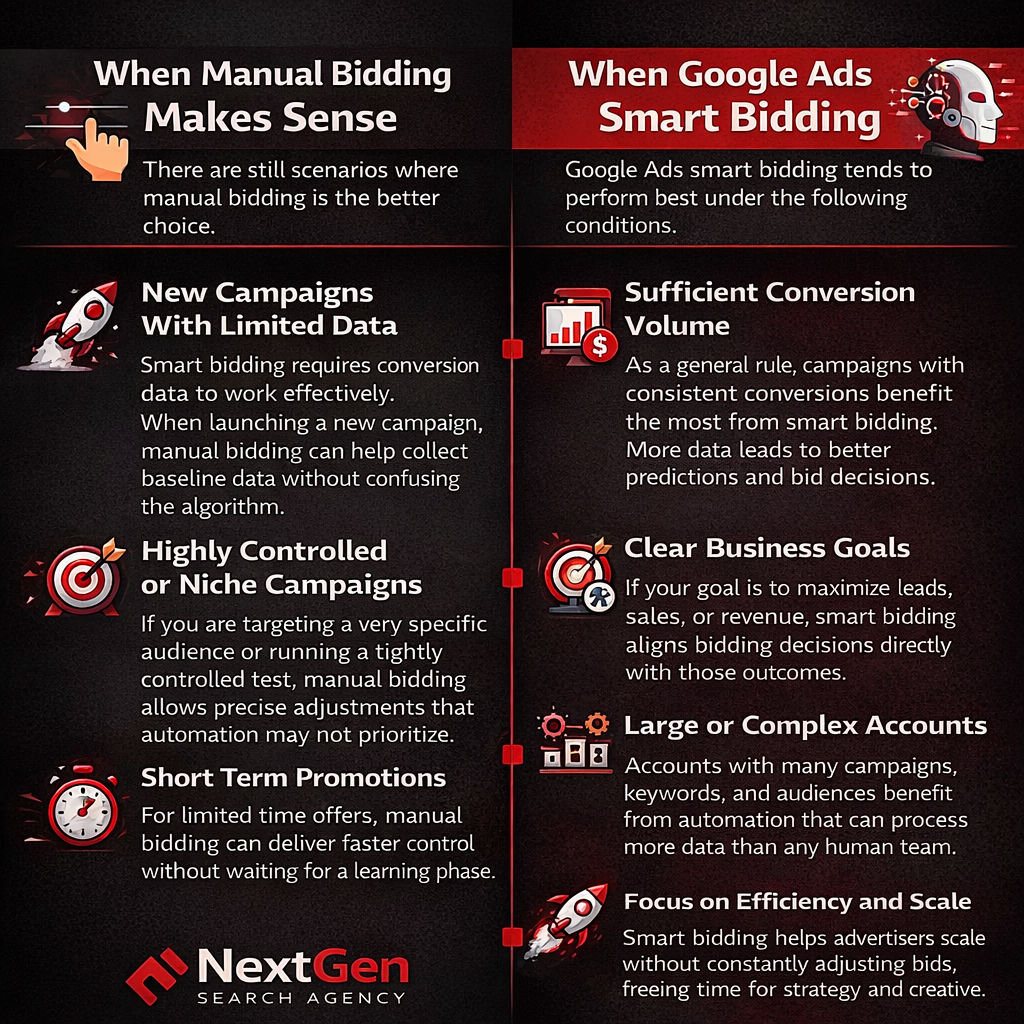
There are still scenarios where manual bidding is the better choice.
New Campaigns With Limited Data
Smart bidding requires conversion data to work effectively. When launching a new campaign, manual bidding can help collect baseline data without confusing the algorithm.
Highly Controlled or Niche Campaigns
If you are targeting a very specific audience or running a tightly controlled test, manual bidding allows precise adjustments that automation may not prioritize.
Short Term Promotions
For limited time offers, manual bidding can deliver faster control without waiting for a learning phase.
Diagnostic and Learning Purposes
Manual bidding is useful for understanding how keywords perform, how auctions behave, and where budget inefficiencies exist.
When Google Ads Smart Bidding Is the Better Option
Google Ads smart bidding tends to perform best under the following conditions.
Sufficient Conversion Volume
As a general rule, campaigns with consistent conversions benefit the most from smart bidding. More data leads to better predictions and bid decisions.
Clear Business Goals
If your goal is to maximize leads, sales, or revenue, smart bidding aligns bidding decisions directly with those outcomes.
Large or Complex Accounts
Accounts with many campaigns, keywords, and audiences benefit from automation that can process more data than any human team.
Focus on Efficiency and Scale
Smart bidding helps advertisers scale without constantly adjusting bids, freeing time for strategy and creative optimization.
The Case for a Hybrid Bidding Strategy
The most effective advertisers rarely choose manual bidding or smart bidding exclusively. Instead, they use a hybrid approach that leverages the strengths of both.
Balancing manual bidding and Google Ads smart bidding allows you to:
- Maintain control where it matters
- Use automation where it adds the most value
- Reduce risk during transitions
- Improve performance over time
A hybrid strategy recognizes that bidding is not one size fits all.
How to Transition From Manual to Smart Bidding
Switching too quickly can hurt performance. A structured transition reduces risk.
Step 1: Validate Conversion Tracking
Smart bidding depends on accurate conversion data. Before switching, ensure:
- Conversion actions are correctly set up
- Values are assigned where applicable
- Data is consistent across campaigns
Without reliable tracking, Google Ads smart bidding cannot optimize effectively.
Step 2: Start With Portfolio or Test Campaigns
Instead of switching everything at once, test smart bidding on select campaigns. Compare performance against manual bidding benchmarks.
Step 3: Choose the Right Smart Bidding Strategy
Match the strategy to your goal:
- Lead generation: Target CPA or Maximize Conversions
- Ecommerce: Target ROAS or Maximize Conversion Value
Avoid aggressive targets during the initial learning period.
Step 4: Allow the Learning Phase to Stabilize
Smart bidding requires time to adjust. Avoid frequent changes during this phase. Monitor trends rather than day to day fluctuations.
Using Manual Controls Alongside Smart Bidding
Balancing does not mean giving up control entirely. Even with Google Ads smart bidding, you can guide performance.
Budget Management
Budgets remain a powerful lever. Smart bidding optimizes within budget constraints, so setting realistic budgets is critical.
Audience Signals
Adding audience segments helps guide smart bidding toward higher quality users.
Campaign Structure
Well structured campaigns improve smart bidding performance by providing clearer signals.
Bid Adjustments Through Segmentation
While smart bidding ignores manual bid adjustments, segmentation through separate campaigns can still influence performance.
Common Mistakes to Avoid
Balancing manual bidding and Google Ads smart bidding requires discipline. Common pitfalls include:
- Switching strategies too frequently
- Setting unrealistic CPA or ROAS targets
- Ignoring data requirements
- Judging performance too early
Patience and consistency are essential for long term success.
Measuring Success in a Balanced Approach
Performance should be measured beyond cost per click.
Key metrics include:
- Conversion rate
- Cost per acquisition
- Return on ad spend
- Lead quality and revenue impact
A balanced strategy focuses on business outcomes, not just platform metrics.
Why Experience Matters in Bidding Strategy
Google Ads smart bidding is powerful, but it is not set and forget. Knowing when to intervene, when to trust the algorithm, and when to fall back on manual control requires experience.
This is where professional guidance makes a difference. Agencies with hands on experience understand how to align automation with business goals rather than letting it run unchecked.
Conclusion: Finding the Right Balance
Balancing manual bidding and Google Ads smart bidding is not about choosing sides. It is about using the right tool at the right time. Manual bidding offers control and insight. Smart bidding delivers efficiency and scale.
For advertisers who want sustainable growth, a hybrid approach often produces the best results. The key is strong data, clear goals, and a willingness to adapt as campaigns mature.
At NextGen Search Agency, we help businesses find that balance. Our team understands both the mechanics of Google Ads smart bidding and the strategic value of manual control. We do not push automation blindly. We align bidding strategies with real business outcomes.
If you want expert guidance on building high performing Google Ads campaigns that convert consistently, talk to NextGen Search Agency, the premier Google Ads agency in the Philippines, today. Let us help you turn ad spend into predictable growth.
Resources
- Google Ads Help Center: Smart Bidding Overview
- Google Ads Conversion Tracking Guide
- Google Ads Best Practices for Automated Bidding



1 Comment
Comments are closed.