Pay per click advertising can feel overwhelming when you first step into it. Campaign types. Bidding strategies. Conversion tracking. Quality Scores. Attribution models.
If you have ever opened a Google Ads dashboard and felt like you were reading a foreign language, you are not alone.
That is exactly why we created this PPC Glossary.
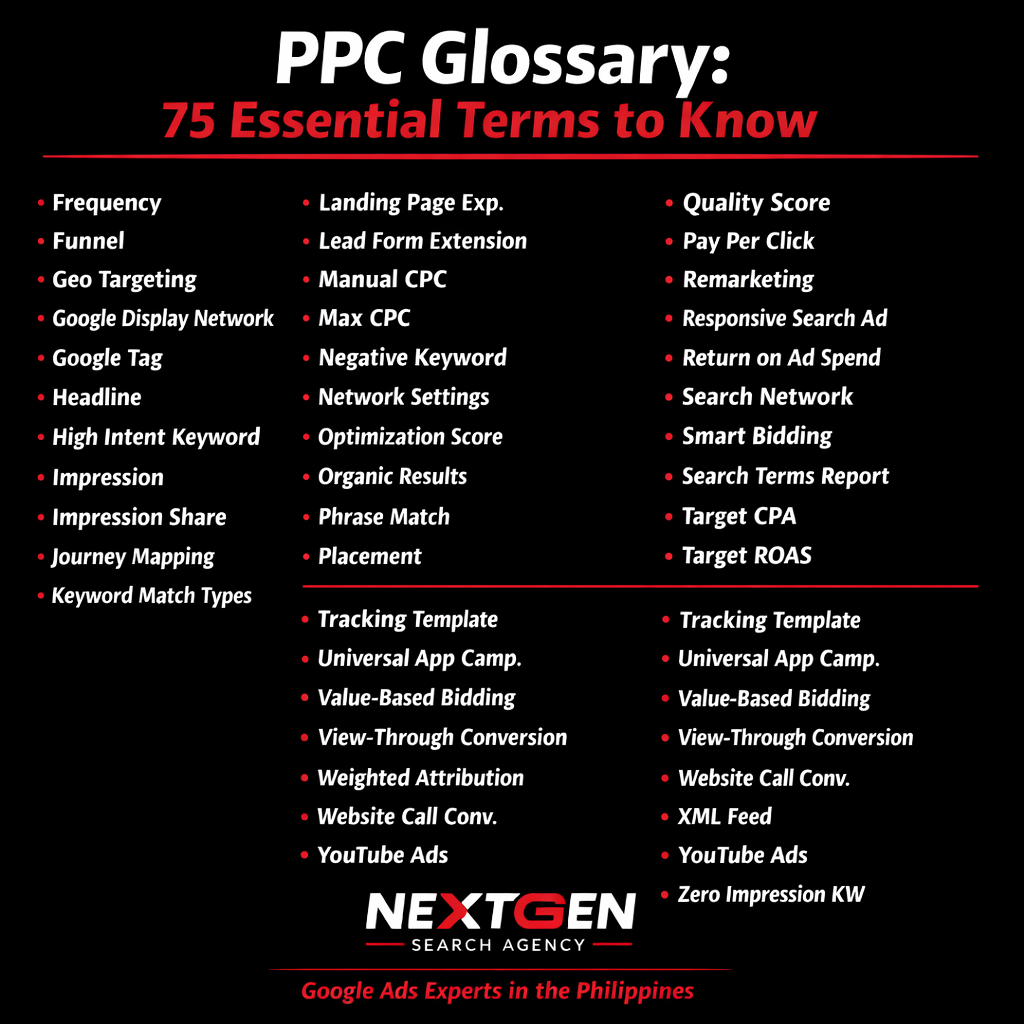
Welcome to the NextGen PPC Glossary, your complete guide to 100 essential pay per click terms every marketer should understand. Whether you manage campaigns in house or work with an agency, this guide will help you make better decisions, ask smarter questions, and protect your ad budget.
Bookmark this page. Share it with your team. Use it as your reference point whenever PPC terminology gets confusing.
Let’s start with the fundamentals.
What Is a PPC Glossary?
A PPC glossary is a structured reference guide that defines the key terms used in pay per click advertising. Instead of surface-level definitions, a well-written ppc glossary explains how each term affects performance, strategy, and budget efficiency.
Pay per click advertising is performance driven. Every setting matters. Every metric tells a story. Understanding terminology allows you to interpret data instead of guessing.
This PPC Glossary focuses heavily on the ecosystem surrounding Google Ads, since it remains the dominant PPC platform globally.
A
1. Ad Auction
The ad auction is the automated process that determines which ads appear in search results and in what order. Every time someone performs a search, an auction happens in real time.
The auction considers several factors, including bid amount, Quality Score, expected click through rate, ad relevance, and landing page experience. It is not simply about who bids the most. Advertisers with better relevance and stronger performance history can outrank competitors even with lower bids.
Understanding the ad auction is foundational to mastering PPC. It explains why improving ad quality often reduces cost per click while increasing visibility.
2. Ad Extensions
Ad extensions are additional pieces of information that expand your ad beyond the standard headline and description. Examples include sitelinks, callouts, structured snippets, phone numbers, and location information.
Extensions improve visibility and increase click through rates because they provide more useful information to users. They also influence Ad Rank.
Within Google Ads, advertisers can configure extensions at the account, campaign, or ad group level.
Strong PPC management always includes proper extension usage because they increase performance without increasing cost per click.
3. Ad Group
An ad group is a container within a campaign that holds related keywords and ads. Ad groups allow advertisers to organize campaigns around specific themes.
For example, a digital marketing agency might have separate ad groups for SEO services, PPC services, and social media advertising.
The tighter the relationship between keywords and ads inside an ad group, the higher the potential Quality Score. This structure directly impacts relevance and conversion rate.
Well-structured ad groups make optimization easier, reporting clearer, and scaling more efficient.
4. Ad Rank
Ad Rank determines your ad position in search results. It is calculated using your bid, Quality Score, expected impact of extensions, and contextual factors like search intent and device.
Higher Ad Rank means better placement. However, you do not necessarily pay your full bid. The actual cost per click depends on the Ad Rank of the competitor below you.
Understanding Ad Rank helps advertisers focus on quality improvements instead of simply increasing bids.
5. Ad Schedule
Ad scheduling allows advertisers to control when ads appear during the day or week. This is useful when performance varies by time.
For example, a B2B company may see stronger performance during business hours. An ecommerce brand might perform best in the evenings.
Scheduling improves budget efficiency by prioritizing high performing time blocks.
B
6. Bid Strategy
A bid strategy determines how you set bids in PPC campaigns. Bid strategies can be manual or automated.
Manual bidding gives advertisers direct control over keyword bids. Automated strategies use machine learning to optimize for conversions, target CPA, or target ROAS.
Choosing the right bid strategy depends on campaign goals, conversion data volume, and account maturity.
7. Broad Match
Broad match is a keyword match type that allows ads to appear for related searches, including synonyms and variations.
While broad match increases reach, it can also trigger irrelevant traffic if not managed carefully.
Smart usage requires strong negative keyword lists and conversion tracking.
8. Budget Cap
A budget cap is the maximum daily amount you are willing to spend on a campaign.
In Google Ads, daily budgets can fluctuate slightly above the set limit, but monthly spending will not exceed the total monthly threshold.
Proper budgeting ensures balanced spend across campaigns and prevents overspending on low performing segments.
9. Bounce Rate
Bounce rate measures the percentage of visitors who leave a landing page without interacting further.
While technically an analytics metric, bounce rate helps evaluate landing page quality in PPC campaigns.
High bounce rates often signal mismatched intent or weak messaging.
10. Brand Campaign
A brand campaign targets keywords that include your business name.
Brand campaigns usually have high click through rates, low cost per click, and strong conversion rates.
They protect your brand from competitors bidding on your name and ensure visibility for high intent searchers.
C
11. Call To Action
A call to action instructs users what to do next. Examples include Buy Now, Get a Quote, or Book a Consultation.
Strong calls to action increase click through rates and conversions.
12. Click Through Rate
Click through rate measures how often people click your ad after seeing it. It is calculated by dividing clicks by impressions.
Higher CTR indicates strong relevance between keyword, ad, and search intent.
CTR directly influences Quality Score and Ad Rank.
13. Conversion
A conversion is a completed desired action. This could be a purchase, form submission, phone call, or download.
Conversion tracking is essential for measuring return on ad spend.
14. Conversion Rate
Conversion rate is the percentage of clicks that result in a conversion.
Improving conversion rate reduces acquisition cost without increasing traffic.
15. Cost Per Click
Cost per click represents the actual amount paid for each click.
CPC varies based on competition, Quality Score, and industry demand.
D
16. Display Network
The Display Network includes websites, apps, and videos where banner ads appear.
Unlike search ads, display ads target users based on interests, placements, or remarketing lists.
17. Dynamic Search Ads
Dynamic Search Ads automatically generate headlines based on website content.
They help capture long tail searches without building extensive keyword lists.
18. Dayparting
Dayparting refers to adjusting bids based on time of day.
It is closely related to ad scheduling and improves performance efficiency.
19. Destination URL
The destination URL is the final webpage users land on after clicking an ad.
Landing page relevance strongly impacts conversion rate and Quality Score.
20. Demand Generation
Demand generation campaigns focus on creating awareness and interest rather than immediate sales.
They typically use video and display placements.
E
21. Exact Match
Exact match triggers ads only when the search closely matches the keyword.
It provides tighter control over traffic quality.
22. Engagement Rate
Engagement rate measures interactions such as video views or ad expansions.
23. Enhanced CPC
Enhanced CPC is a semi automated bidding strategy that adjusts manual bids based on conversion likelihood.
24. Exclusions
Exclusions prevent ads from showing for certain audiences or placements.
25. Expected Click Through Rate
Expected CTR is a component of Quality Score that predicts ad performance.
F
26. Frequency
Frequency measures how many times the same user sees your ad within a specific time period. It is most commonly used in display and video campaigns rather than search campaigns.
High frequency can increase brand recall, but excessive repetition may lead to ad fatigue. When users see the same message too often, engagement rates can decline and negative brand perception may increase.
Monitoring frequency helps advertisers balance exposure and user experience. If performance drops while frequency rises, it may signal a need for creative refresh, audience expansion, or tighter targeting.
Smart PPC management treats frequency as both a performance and branding metric. It is not only about impressions, but about how repeated exposure influences behavior.
27. Funnel
In PPC advertising, the funnel represents the different stages a customer goes through before converting. These stages typically include awareness, consideration, and decision.
Top of funnel campaigns aim to introduce a product or service to new audiences. Middle of funnel campaigns nurture interest and build trust. Bottom of funnel campaigns target high intent users ready to take action.
Understanding funnel positioning helps advertisers tailor messaging and bidding strategies. For example, awareness campaigns often optimize for engagement, while decision stage campaigns focus on conversion metrics.
Successful PPC strategies align campaign structure with funnel stages rather than treating all traffic equally.
G
28. Geo Targeting
Geo targeting allows advertisers to control where their ads appear based on location. This can include countries, regions, cities, postal codes, or even radius targeting around a physical location.
Location targeting is especially important for local businesses, service providers, and franchise models. It prevents wasted spend outside relevant service areas.
Within Google Ads, advertisers can also adjust bids based on geographic performance. If one city converts at a higher rate, bids can be increased for that location.
Precise geo targeting improves return on ad spend and ensures ads reach audiences with real purchasing potential.
29. Google Display Network
The Google Display Network is a collection of millions of websites, apps, and properties where visual ads can appear. It is part of Google Ads and focuses on awareness and remarketing rather than direct search intent.
Advertisers can target users based on interests, demographics, placements, and remarketing lists. Display campaigns are often used to re engage previous website visitors.
Performance on the Display Network depends heavily on audience targeting and creative quality. Clear messaging and strong visuals significantly impact results.
When used strategically, display advertising supports search campaigns by strengthening brand recognition.
30. Google Tag
A Google Tag is a tracking code placed on a website to measure conversions and user interactions. It allows advertisers to track actions such as purchases, form submissions, or button clicks.
Accurate tracking is the foundation of performance optimization. Without proper tagging, automated bidding strategies cannot function effectively.
Tag implementation must be tested to ensure conversion data is recorded correctly. Even small tracking errors can distort performance metrics.
Reliable data ensures that optimization decisions are based on measurable outcomes rather than assumptions.
H
31. Headline
The headline is the most prominent part of a search ad. It captures attention and communicates primary value.
Effective headlines align closely with the search query. Including the keyword naturally improves relevance and click through rate.
Within responsive search ads, multiple headlines can be tested automatically to determine the best performing combinations.
Strong headline writing blends clarity, urgency, and benefit driven messaging without misleading claims.
32. High Intent Keyword
A high intent keyword signals that the user is ready to take action. Examples include phrases containing buy, quote, hire, or near me.
High intent keywords often have higher cost per click because competition is stronger. However, they typically produce better conversion rates.
Successful PPC strategies prioritize high intent traffic while maintaining cost control.
I
33. Impression
An impression is recorded each time your ad is displayed to a user. It does not require interaction.
Impressions indicate visibility, while clicks indicate engagement. Monitoring impression volume helps evaluate reach and auction participation.
Low impressions may signal limited budget, restrictive targeting, or low search volume.
34. Impression Share
Impression share represents the percentage of total eligible impressions your ads received.
If your impression share is 60 percent, that means your ads appeared in 60 percent of auctions where they were eligible.
Lost impression share can occur due to budget limitations or low Ad Rank. Monitoring this metric helps identify growth opportunities.
J
35. Journey Mapping
Journey mapping analyzes the path users take before converting. It helps advertisers understand which touchpoints contribute to sales.
PPC often plays multiple roles in a journey. A user may first see a display ad, later click a search ad, and finally convert through remarketing.
Understanding the full journey improves attribution decisions and budget allocation.
K
36. Keyword Match Types
Keyword match types control how closely a search query must match a keyword before triggering an ad.
Match types include broad match, phrase match, and exact match. Each offers different levels of control and reach.
Balancing match types ensures both scale and precision.
L
37. Landing Page Experience
Landing page experience is a component of Quality Score. It evaluates how relevant, transparent, and user friendly your landing page is.
Factors include page speed, mobile responsiveness, content relevance, and navigation clarity.
Improving landing page experience lowers cost per click and increases conversion rate.
38. Lead Form Extension
Lead form extensions allow users to submit contact information directly within the ad.
This reduces friction and captures high intent leads quickly.
Proper follow up systems are critical for maximizing return.
M
39. Manual CPC
Manual CPC is a bidding strategy where advertisers set maximum bids for each keyword.
It offers control but requires active management.
Manual bidding is often useful for new accounts gathering data.
40. Maximum CPC
Maximum CPC is the highest amount you are willing to pay for a click.
Actual CPC is often lower due to auction dynamics.
N
41. Negative Keyword
A negative keyword prevents ads from showing for specific search terms.
For example, if you sell premium services, you may add free as a negative keyword.
Strong negative keyword management protects budget and improves traffic quality.
42. Network Settings
Network settings determine where ads appear, such as search network, display network, or partner sites.
Proper configuration prevents unintended placements.
O
43. Optimization Score
Optimization Score is a recommendation metric within Google Ads that suggests account improvements.
While helpful, not all recommendations align with business goals. Advertisers should evaluate suggestions strategically.
44. Organic Results
Organic results are unpaid listings in search engines.
PPC ads appear above or alongside these listings.
Understanding the relationship between organic and paid results supports integrated strategy.
P
45. Phrase Match
Phrase match triggers ads when a search contains the keyword phrase in close variation.
It balances reach and control.
46. Placement
A placement refers to a specific website or app where display ads appear.
Placement analysis helps identify high performing or low quality sites.
47. Quality Score
Quality Score is a rating from 1 to 10 that measures keyword relevance, expected click through rate, and landing page experience.
Higher Quality Scores lower cost per click and improve Ad Rank.
48. Pay Per Click
Pay per click is an advertising model where advertisers pay only when users click their ads.
It provides measurable and scalable traffic acquisition.
R
49. Remarketing
Remarketing targets users who previously visited your website.
It increases conversion rates by re engaging interested audiences.
50. Responsive Search Ad
Responsive search ads allow multiple headlines and descriptions to be tested automatically.
Machine learning identifies the best combinations.
51. Return On Ad Spend
Return on ad spend measures revenue generated for every unit of ad spend.
It is calculated by dividing revenue by ad cost.
S
52. Search Network
The Search Network displays ads on search engine results pages.
It targets high intent traffic.
53. Smart Bidding
Smart Bidding uses machine learning to optimize bids for conversions or value.
It requires accurate tracking and sufficient data.
54. Search Terms Report
The search terms report shows actual queries that triggered ads.
It is essential for adding negative keywords and refining targeting.
T
55. Target CPA
Target CPA bidding aims to generate conversions at a specified cost per acquisition.
It automates bid adjustments based on likelihood of conversion.
56. Target ROAS
Target ROAS bidding aims to achieve a desired return on ad spend.
It is often used in ecommerce campaigns.
57. Tracking Template
A tracking template adds parameters to URLs for analytics tracking.
It supports performance analysis across channels.
U
58. Universal App Campaign
Universal App Campaigns promote mobile applications across search, display, and video placements automatically.
They rely heavily on machine learning.
V
59. Value Based Bidding
Value based bidding focuses on conversion value rather than volume.
It prioritizes high revenue actions.
60. View Through Conversion
A view through conversion occurs when a user sees an ad but does not click, then later converts.
This metric is common in display campaigns.
W
61. Weighted Attribution
Weighted attribution assigns credit to multiple touchpoints in a conversion path.
It provides deeper performance insight.
62. Website Call Conversion
Website call conversion tracks phone calls made from your website after ad clicks.
It is essential for service businesses.
X
63. XML Feed
An XML feed is used in shopping campaigns to upload product data.
Accurate feeds improve visibility and relevance.
Y
64. YouTube Ads
YouTube ads appear on the YouTube platform and are managed through Google Ads.
They support awareness, consideration, and remarketing objectives.
Z
65. Zero Impression Keyword
A zero impression keyword has not generated any impressions.
It may require bid increases, broader match types, or removal.
Understanding terminology is the foundation of profitable advertising. This PPC Glossary exists to eliminate confusion and replace it with clarity.
When you understand metrics like Ad Rank, Quality Score, conversion rate, and bid strategy, you stop guessing and start optimizing.
That said, knowing the terms and executing profitable campaigns are two different things. PPC performance requires constant testing, audience refinement, budget calibration, and landing page optimization.
At NextGen Search Agency, we work with businesses across the Philippines and international markets to build data driven PPC strategies focused on measurable revenue growth. We prioritize sustainable scaling, transparent reporting, and strategic testing rather than short term vanity metrics.
If you want to turn your ad budget into a predictable acquisition channel, visit https://www.nextgensearch.agency and explore how we approach Google Ads strategy.
Your budget deserves more than trial and error. Let’s build campaigns that convert.
Resources
Google Ads Help Center
Google Skillshop
Think with Google
Google Analytics Help
Search Engine Journal PPC Section