
Running Google Ads today is very different from how it worked just a few years ago. Manual bid adjustments, constant monitoring, and spreadsheet heavy optimizations used to be the norm. Now, automation plays a much bigger role, and one of the most talked about features is smart bidding.
Smart bidding is designed to help advertisers improve performance by using machine learning to optimize bids in real time. Instead of manually setting bids for keywords or ad groups, smart bidding automatically adjusts bids based on the likelihood of conversion.
This article explains what smart bidding is, how it works, when it makes sense to use it, and when it might not. The goal is to give you a clear, practical understanding so you can decide whether smart bidding aligns with your campaign objectives.
What Is Smart Bidding
Smart bidding is a set of automated bidding strategies within Google Ads that use machine learning to optimize for conversions or conversion value. It analyzes large amounts of data at auction time to determine the optimal bid for each search.
Unlike manual bidding, smart bidding considers contextual signals that are impossible to manage at scale. These signals include device, location, time of day, language, browser, and user behavior patterns.
The core idea behind smart bidding is simple. Instead of treating all clicks equally, Google adjusts bids based on how likely a user is to complete a desired action.
How Smart Bidding Works
Smart bidding operates at auction time. Every time a user searches on Google, an auction happens in milliseconds. Smart bidding evaluates the available signals for that specific auction and adjusts the bid accordingly.
Some of the key signals considered include:
- Device type
- User location
- Time of day
- Search query intent
- Browser and operating system
- Past user behavior
By combining these signals with historical conversion data, smart bidding predicts the likelihood of conversion and sets a bid designed to meet your campaign goal.
This process happens automatically and continuously, allowing campaigns to adapt to changes in user behavior without manual intervention.
Types of Smart Bidding Strategies
Google Ads offers several smart bidding strategies, each designed for a specific objective. Choosing the right one is critical to success.
Target CPA
Target CPA focuses on generating conversions at or below a specific cost per acquisition. Google automatically sets bids to try to achieve as many conversions as possible within your target.
This strategy works well for lead generation campaigns where conversion volume matters more than individual conversion value.
Target ROAS
Target ROAS is designed for ecommerce advertisers who track revenue. Instead of optimizing for conversions alone, this strategy aims to maximize conversion value while maintaining a target return on ad spend.
It requires accurate conversion value tracking to perform effectively.
Maximize Conversions
Maximize conversions uses your daily budget to generate as many conversions as possible. There is no target CPA, which gives Google more flexibility in bidding.
This strategy is often used during testing phases or when advertisers want to scale quickly.
Maximize Conversion Value
Maximize conversion value focuses on driving the highest possible conversion value within your budget. It is similar to maximize conversions but prioritizes revenue or lead quality when values are assigned.
Enhanced CPC
Enhanced CPC is sometimes grouped with smart bidding. It adjusts manual bids up or down based on conversion likelihood while still allowing some manual control.
Benefits of Using Smart Bidding
Smart bidding offers several advantages, especially for accounts with sufficient data.
Some of the main benefits include:
- Real time bid adjustments at auction level
- Ability to process large amounts of data
- Reduced manual workload
- Faster adaptation to changes in user behavior
- Improved efficiency for conversion focused campaigns
For many advertisers, smart bidding frees up time to focus on strategy, creatives, and landing page optimization.
Limitations of Smart Bidding
Despite its advantages, smart bidding is not a perfect solution for every campaign.
Some common limitations include:
- Requires sufficient conversion data to perform well
- Less transparency in bid decisions
- Learning periods that can impact short term performance
- Limited control for highly specific bidding needs
Advertisers with low conversion volume or very niche markets may struggle to see consistent results.
When Smart Bidding Works Best
Smart bidding tends to perform best in accounts with:
- Consistent conversion tracking
- Clear campaign goals
- Stable budgets
- Adequate conversion volume
Google generally recommends at least 30 conversions per month for Target CPA and higher volumes for Target ROAS.
Campaigns that meet these criteria give smart bidding enough data to make reliable predictions.
When Smart Bidding May Not Be Ideal
Smart bidding may not be the best option if:
- Conversion tracking is inaccurate
- Conversion volume is very low
- You need strict control over bids
- Campaign goals change frequently
In these cases, manual bidding or enhanced CPC may offer better control and stability.
Smart Bidding vs Manual Bidding
The main difference between smart bidding and manual bidding lies in how decisions are made.
Manual bidding relies on human input and historical averages. Smart bidding relies on machine learning and real time signals.
Manual bidding offers control and transparency. Smart bidding offers scale and efficiency. The right choice depends on campaign complexity, data availability, and business goals.
Many advanced advertisers use a hybrid approach, starting with manual bidding and transitioning to smart bidding once enough data is collected.
Setting Up Smart Bidding Correctly
Proper setup is critical to success with smart bidding.
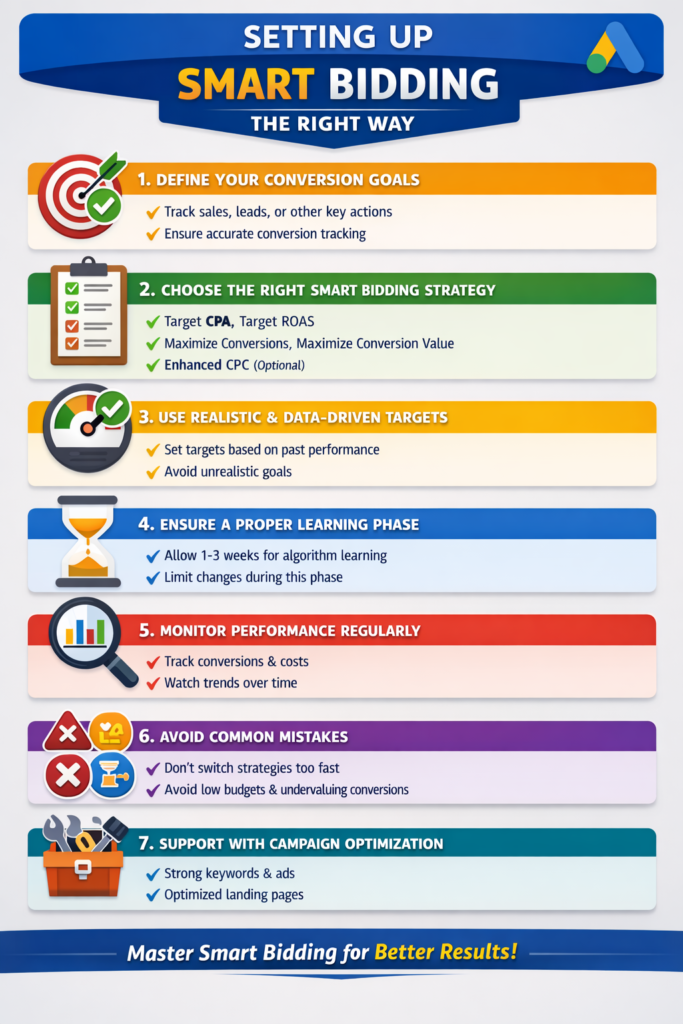
Ensure Accurate Conversion Tracking
Before enabling smart bidding, verify that conversions are tracked correctly. This includes form submissions, purchases, calls, or other meaningful actions.
Assign Realistic Targets
Unrealistic Target CPA or ROAS goals can restrict performance. Start with targets close to historical averages and adjust gradually.
Allow Learning Time
Smart bidding requires a learning period. Avoid making frequent changes during this phase, as it can reset the learning process.
Monitor Performance Regularly
Automation does not mean set and forget. Review performance trends, conversion quality, and budget utilization.
Common Smart Bidding Mistakes to Avoid
Even experienced advertisers can struggle with smart bidding if basic principles are ignored.
Common mistakes include:
- Changing targets too frequently
- Using smart bidding with poor conversion data
- Expecting immediate results
- Ignoring search terms and audience signals
- Treating all conversions as equal when they are not
Avoiding these issues helps smart bidding perform more consistently over time.
Smart Bidding and Conversion Quality
Not all conversions have the same value. Smart bidding performs best when conversion actions reflect real business outcomes.
Assigning values to conversions allows Google to prioritize higher quality leads or higher revenue actions. This improves overall return rather than just increasing volume.
Smart Bidding in Competitive Markets
In highly competitive industries, smart bidding can be both an advantage and a challenge.
On one hand, real time bid adjustments help capture high intent searches. On the other hand, aggressive bidding strategies can increase costs if targets are not set carefully.
This makes strategic oversight essential, even when automation is in place.
Measuring Smart Bidding Performance
Evaluating smart bidding requires looking beyond basic metrics.
Key indicators include:
- Conversion volume and cost
- Conversion value and return on ad spend
- Lead quality or sales quality
- Budget efficiency
Performance should be assessed over longer time frames to account for learning periods and seasonality.
The Role of Smart Bidding in a Broader Google Ads Strategy
Smart bidding is a tool, not a strategy on its own. It works best when combined with strong account structure, relevant keywords, compelling ad copy, and optimized landing pages.
Without these foundations, even the best bidding strategy will struggle.
Smart bidding has changed how Google Ads campaigns are managed. By using machine learning and real time signals, it allows advertisers to optimize bids at a scale that manual methods cannot match.
However, smart bidding is not a shortcut. It requires accurate data, realistic goals, and ongoing oversight to deliver consistent results. When implemented correctly, it can improve efficiency, scalability, and overall campaign performance.
At NextGen Search Agency, smart bidding is used as part of a structured Google Ads strategy rather than a one size fits all solution. Our team evaluates data quality, business goals, and market conditions before applying automation. This approach helps ensure smart bidding supports growth instead of inflating costs.
If you want to know whether smart bidding is the right move for your Google Ads campaigns, work with a Google Ads agency in the Philippines that understands both automation and strategy. Visit nextgensearch.agency to learn how we help businesses turn ad spend into consistent, high quality leads.
Resources
- Google Ads Smart Bidding documentation
- Google Ads Help Center
- Google Skillshop Google Ads courses
- Think with Google insights